


Zürichsee villa
There is a particular moment that every owner of a HIRT kinetics installation describes in strikingly similar terms: the first time their window front—sometimes weighing several tonnes—begins its silent descent into the floor, erasing the boundary between interior and landscape in a matter of seconds. It is, they say, a moment that never loses its magic.
Founded in 1988 by Stefan Hirt in the Swiss canton of Glarus, HIRT kinetics has spent nearly four decades perfecting a single, deceptively simple idea: vertical opening. Inspired by the architectural vision of Ludwig Mies van der Rohe, the company’s retractable window fronts—known as “drop fronts”—use a precision-engineered counterweight system to make glass panels of extraordinary size glide silently downward, disappearing entirely below floor level. No motors straining against gravity, no mechanical noise—just physics, deployed with Swiss precision.
Today, HIRT kinetics installations grace residences and commercial properties across more than 30 countries, from Beverly Hills to Bermuda, from the Swiss Alps to the shores of Sydney. Each one is custom-manufactured at the company’s factory in Mollis, Switzerland. We look at three projects that reveal how this technology transforms not just buildings, but the way their inhabitants experience daily life.
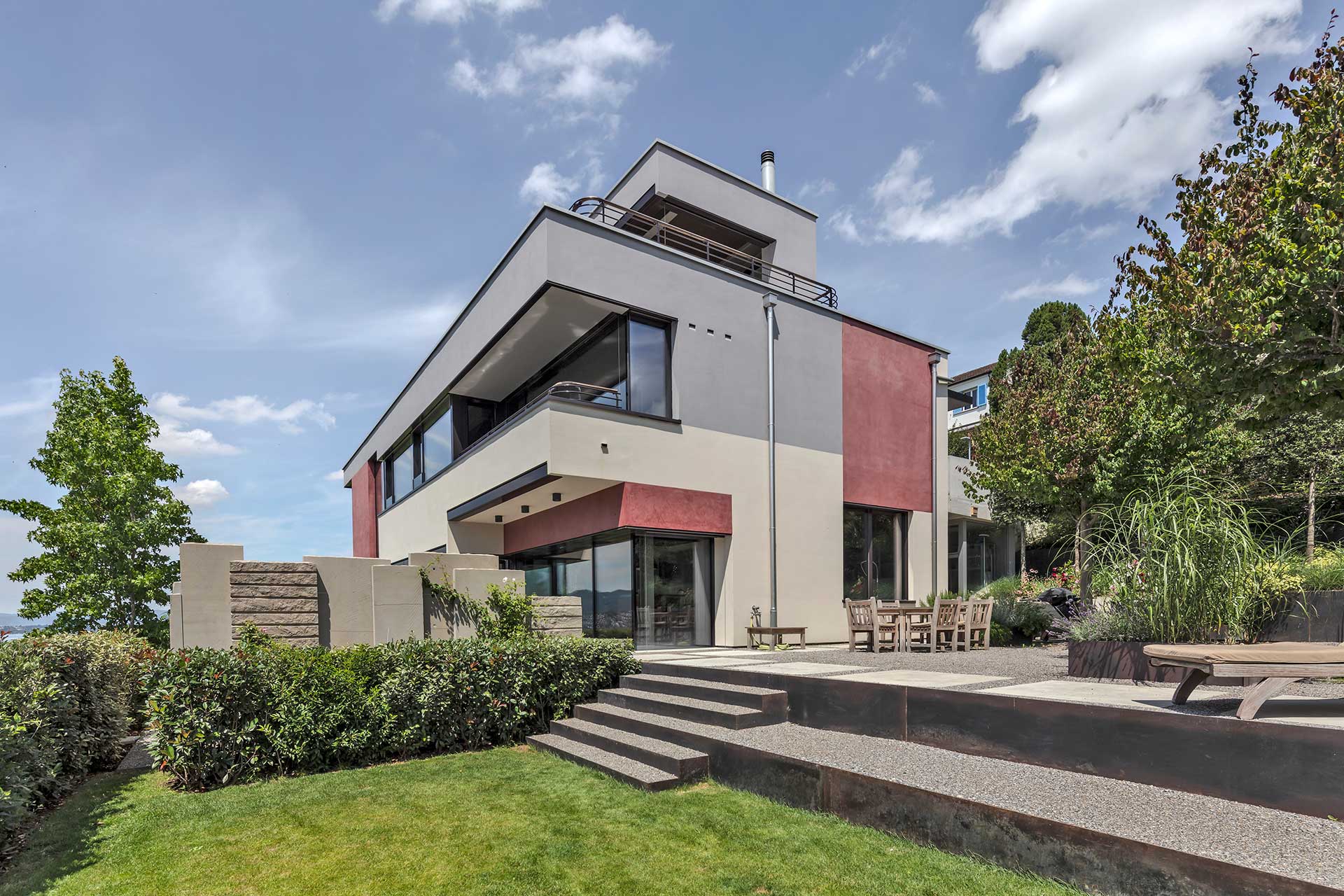
Villa above Lake Zurich © René Dürr
A Bauhaus Legacy Reimagined on Lake Zurich
High above Lake Zurich, on an undeveloped hillside surrounded by vineyards, stands a villa that pays tribute to one of architecture’s most celebrated experiments: the Case Study House No. 8, designed by Charles and Ray Eames in Los Angeles in 1949. Conceived by the acclaimed Zurich-based practice Meili & Peter Architekten, this residence translates the spirit of mid-century modernism into a contemporary Swiss context—and then takes it a decisive step further.
The building’s ground-floor glass façade is composed entirely of HIRT kinetics SF Special drop fronts. At the touch of a button, the panoramic windows descend silently into the earth, opening the living spaces on three sides to a sweeping panorama of the lake, the surrounding hills, and the distant peaks beyond. The transition is seamless: the threshold aligns with the surrounding floor to the millimetre, creating a perfectly level connection between interior and terrace.
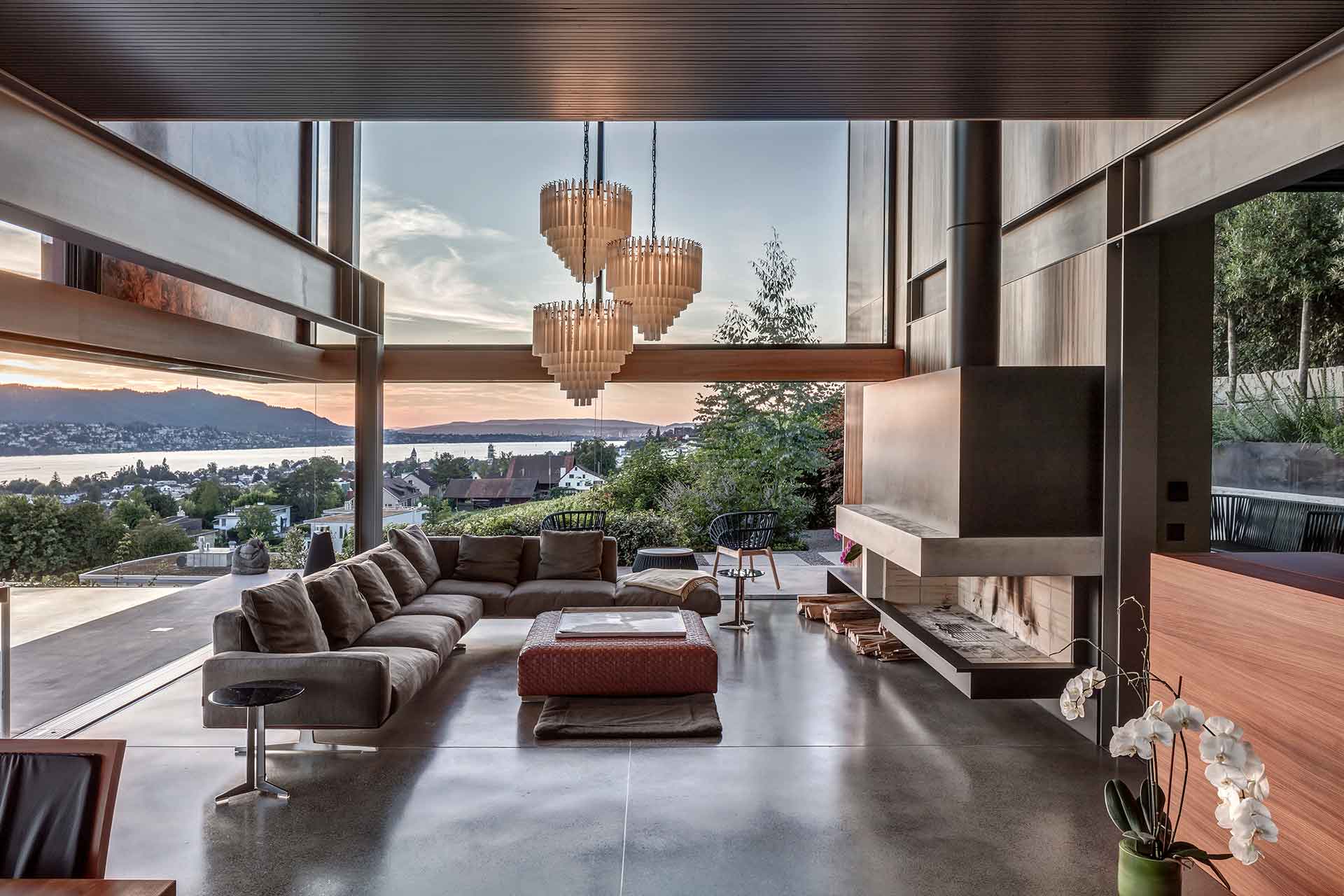
Interior with drop fronts open, daylight © René Dürr
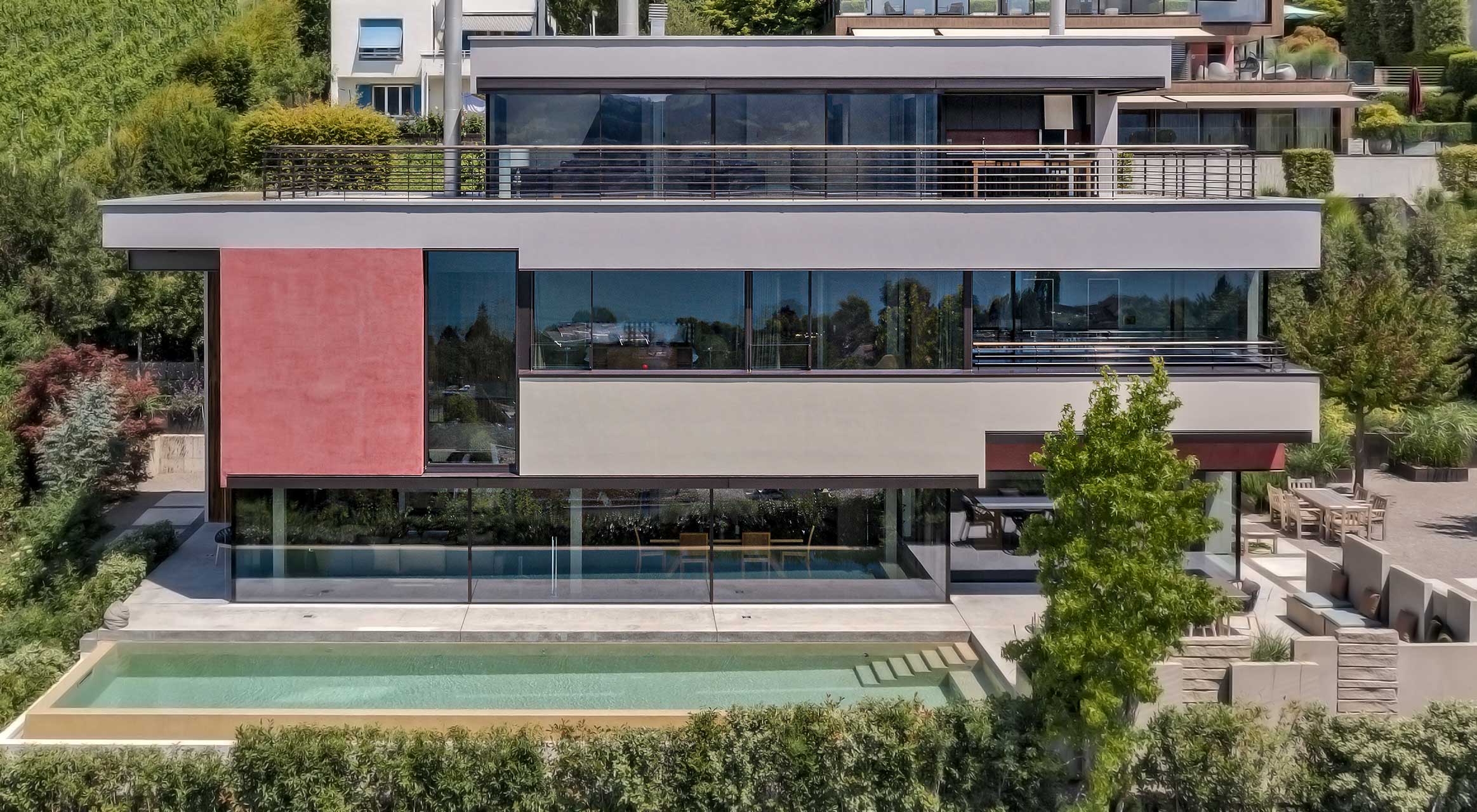
Panoramic view through open façade © René Dürr
What makes this project particularly remarkable is its integration of materials. Panels of Caucasian root wood, Japanese ash, and French cherry create a warm, tactile interior that stands in deliberate contrast to the transparency of the glass. The HIRT kinetics mechanism is entirely concealed within the building’s substructure, leaving the wood-panelled façade clean and uninterrupted—a composition that the architects liken to a painting by Piet Mondrian.
“The combination of finest materials and the uncompromising way in which the opening-up of the room has been implemented here are what make this such an outstanding project.” — Stefan Hirt, Founder
When the windows are lowered on a clear day, the elevated position reveals the full sweep of the Zurich region — vineyards cascading down the hillside, the shimmering expanse of the lake, the Alps beyond. The air itself changes: you feel the warmth of the sun on the living room floor, catch the scent of the garden, sense the shift from enclosed stillness to open sky. Architecture, in this moment, becomes a sensory experience.
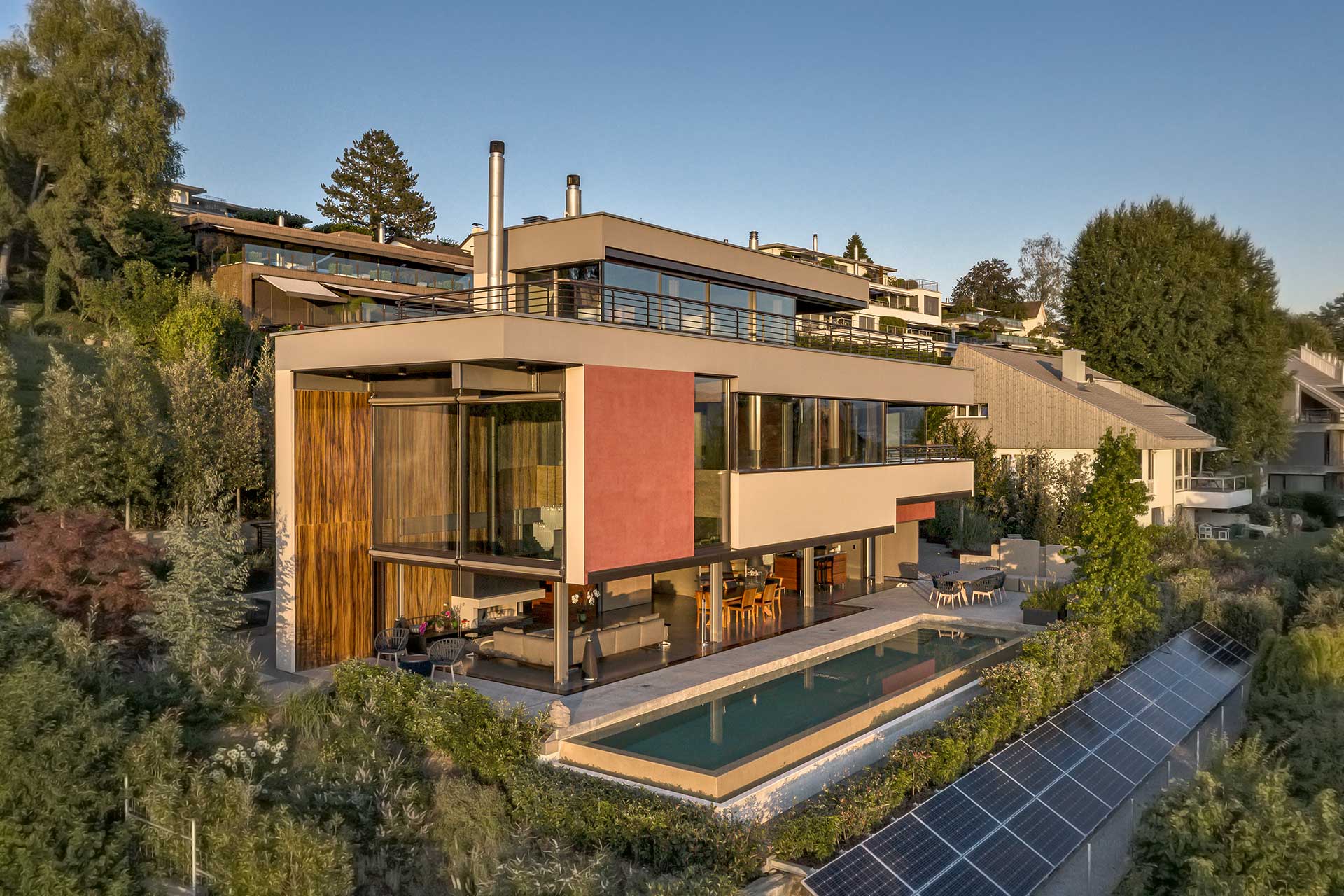
The combination of glass, wood, and concrete elements gives structure to the building and creates a feeling of arrival © René Dürr
The Residence That Captivated 10 Million Viewers
Some projects find an audience far beyond the architectural world. A recent Instagram Reel featuring a HIRT kinetics installation has amassed over 10 million views—a figure that speaks to the universal fascination of watching something monumental move with unexpected grace.
10.7 million views on Instagram
The footage captures a moment of pure architectural theatre: an expansive glass façade begins its descent, and within seconds the division between a meticulously designed interior and a lush outdoor setting simply ceases to exist. The sheer scale of the moving element—combined with the silence and fluidity of its motion—is what stops viewers mid-scroll.
The viral reach of this project underscores something that the numbers alone cannot convey: HIRT kinetics’ installations provoke an emotional response. They challenge our expectations of what a building can do. Walls, we instinctively understand, are permanent. When they move—and move this gracefully—something shifts in our perception of the space, and of what is possible.
For the homeowner, of course, the spectacle is only part of the story. The practical benefits are equally compelling. When the drop front is raised, the home is sealed with a pneumatic gasket system originally developed for clean rooms, delivering Class 4 air permeability and E1500 rain impermeability. When it is lowered, the living space effectively doubles, merging with the garden, pool deck, or terrace in a way that no conventional sliding door can replicate.
Karlsruhe villa
A Contemporary Villa in Karlsruhe
Among the most recent additions to the HIRT kinetics’ portfolio is a striking modern villa in Karlsruhe, Germany—captured on film just days ago in footage shown here for the first time. Set behind a pristine infinity pool, the residence features a ground-floor living area whose entire rear elevation is fitted with HIRT kinetics drop fronts.
The architectural language is boldly contemporary: clean white surfaces, generous proportions, and a layered composition of stone, glass, and steel that draws the eye through the building and out towards the garden beyond. The HIRT kinetics element occupies the full width and height of the ground floor opening, creating what amounts to a frameless portal between the interior and the pool terrace.
This project exemplifies a growing trend in German residential architecture: the desire for indoor-outdoor living that was once associated primarily with Mediterranean or Californian climates. With HIRT kinetics’ highly insulated aluminium profiles—achieving a Uf value as low as 1.364 W/m²K—and their pneumatic sealing technology, homeowners in northern European climates can enjoy the same open-air lifestyle without compromising on thermal comfort during the colder months.
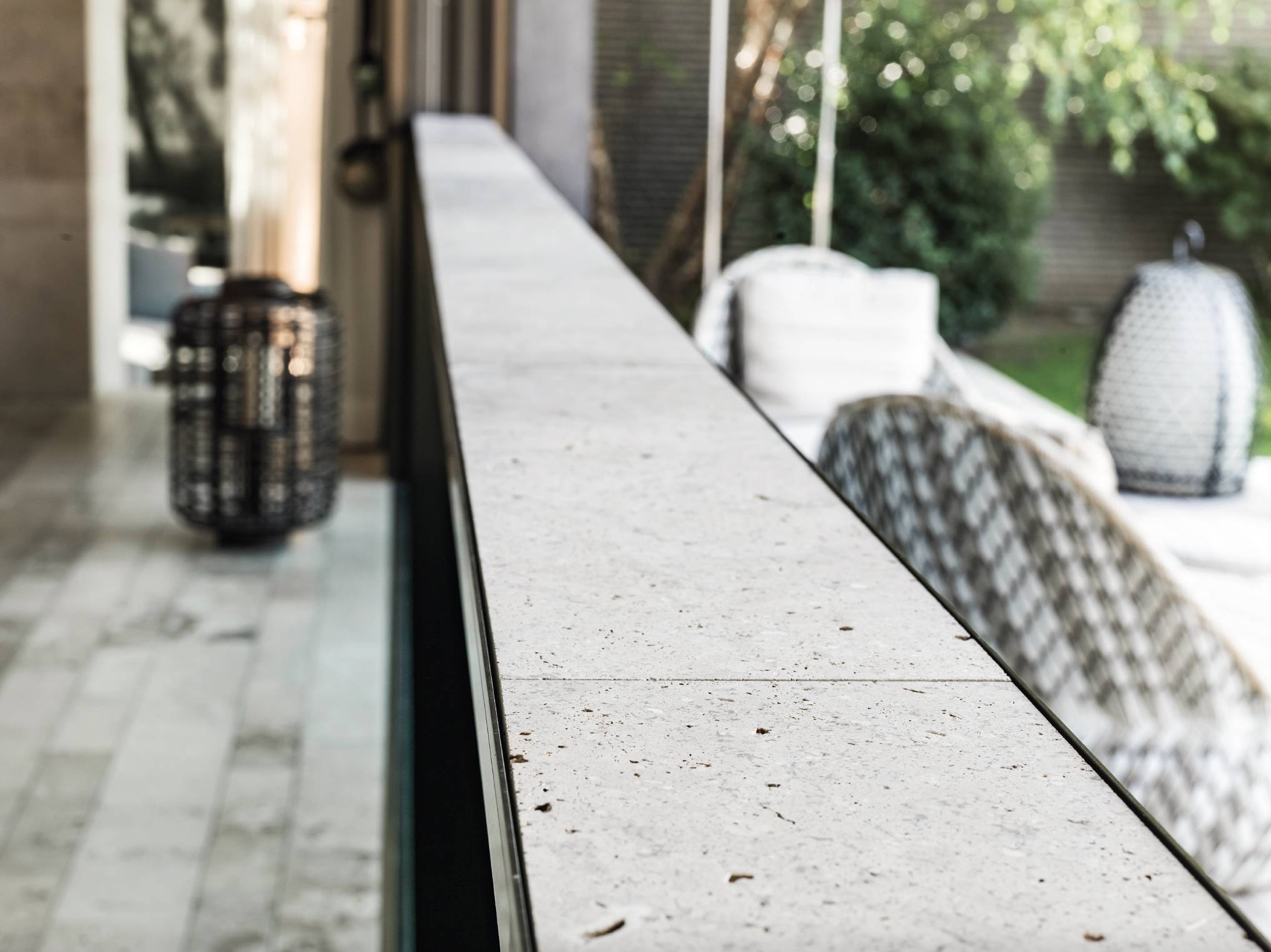
A bespoke threshold detail further enhances the seamless integration: the surrounding floor material—in this case stone—is laid directly onto the upper frame of the drop front, so that when the glass panel is fully retracted, the threshold becomes virtually invisible, indistinguishable from the terrace itself.
The Craft Behind the Curtain
What unites these three projects—and every HIRT kinetics installation worldwide—is the principle that Stefan Hirt describes as “the laws of physics deployed creatively.” Each drop front is balanced by a counterweight precisely calibrated to its mass, which means the electric motor merely initiates the movement; gravity and equilibrium do the rest. This is why the motion is so uncannily smooth, and why HIRT kinetics can move glass panels weighing up to 3.5 tonnes with minimal energy consumption.
Every system is custom-engineered and manufactured entirely in Switzerland. The company’s products carry CE certification and have been validated by Suva, the Swiss Accident Insurance Fund. Safety features include laser scanners for fully automatic operation, dead-man switches for semi-automatic use, and emergency manual override in case of power failure. Maintenance intervals are a reassuringly modest two years, and remote diagnostics are available for all models.
The design possibilities extend far beyond standard glass panels. HIRT kinetics drop fronts can be executed with corner glazing at any angle, integrated hinged or sliding doors, curved glass, solid stone or wood cladding, and even gable or arch configurations. Materials range from anodised aluminium and stainless steel to bronze and natural stone. For architects, the system offers a rare combination: near-limitless creative freedom, backed by the reliability of Swiss precision engineering.
HIRT kinetics AG
Oberrütelistr. 11 | 8753 Mollis | Switzerland
Web: hirtkinetics.com
Tel: +41 44 817 60 60
Email: info@hirtkinetics.com
Instagram: @hirtkinetics
Facebook: @hirtkinetics